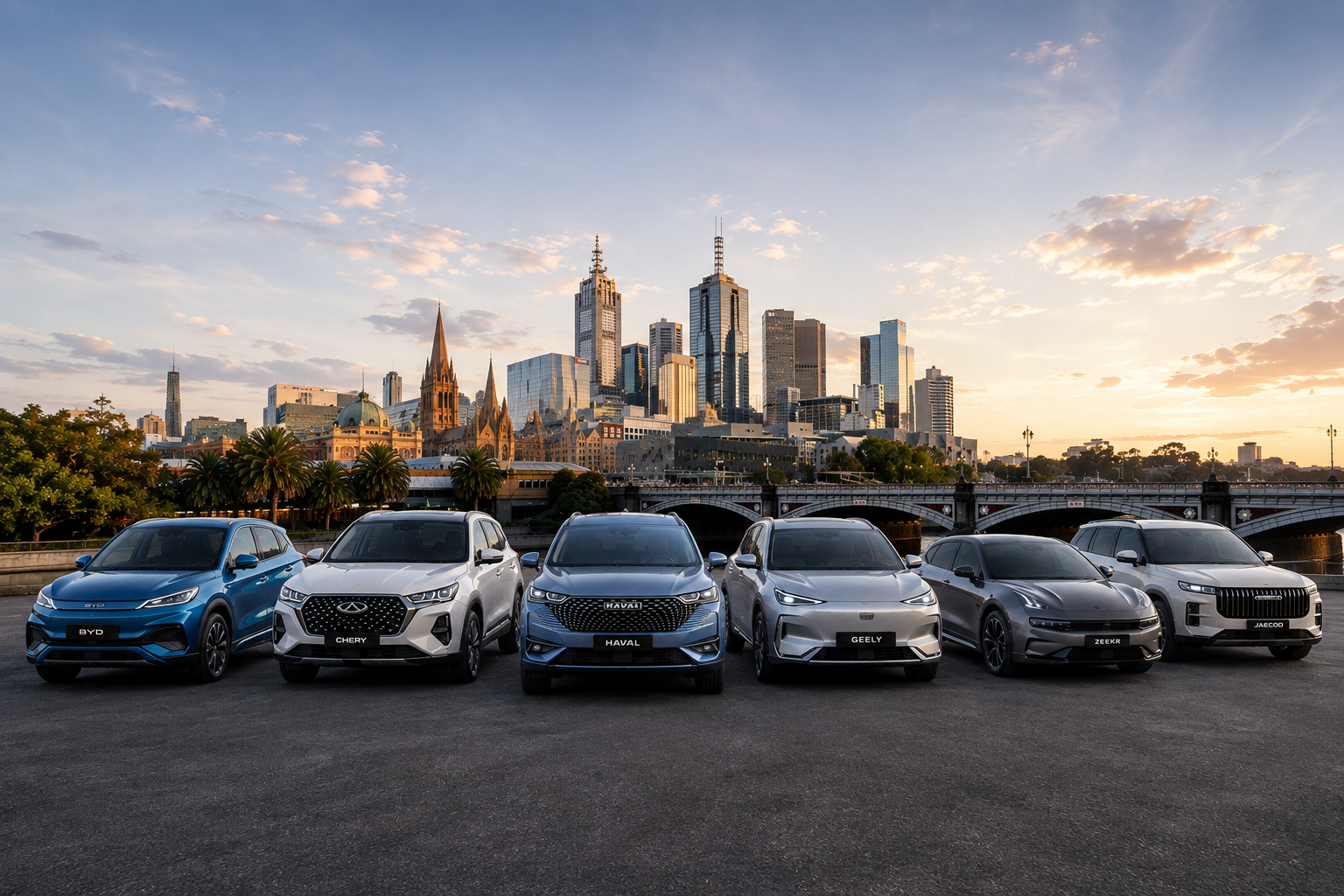
If you’ve been shopping for a new car lately, you may have found yourself asking a question that would have been unusual just a few years ago:
Who makes that?
Australian roads were once dominated by an extremely familiar collection of badges. Toyota, Ford, Holden, Mazda, Mitsubishi, Nissan, Hyundai and Subaru were household names, while European manufacturers occupied much of the premium end of the market.
Today, the Australian new-car landscape looks very different.
Names including BYD, Chery, GWM, Geely, Zeekr, Jaecoo, Omoda and XPeng are becoming increasingly familiar, while even more manufacturers are preparing to compete for Australian buyers.
So, why are so many new car brands suddenly arriving in Australia, and what does it mean for motorists?
Australia Has Become a Battleground for Global Car Brands
Australia is an interesting market for international vehicle manufacturers.
We no longer manufacture passenger cars on a large scale locally, which means virtually every new vehicle sold here is imported.
At the same time, Australians buy everything from compact city cars and family SUVs to dual-cab utes, luxury vehicles, four-wheel drives, hybrids and electric vehicles.
That creates opportunities for manufacturers capable of offering the right combination of price, technology, features and design.
And increasingly, Chinese manufacturers are taking advantage of that opportunity.
Chinese Cars Have Changed Dramatically
Some Australian motorists still associate Chinese vehicles with the inexpensive models that first arrived here many years ago.
The industry has moved a long way since then.
Modern Chinese manufacturers are producing everything from affordable small SUVs to plug-in hybrids, electric utes, performance cars and premium EVs.
They are also competing heavily on technology.
Large infotainment displays, 360-degree cameras, adaptive cruise control, panoramic roofs, electric tailgates and advanced driver assistance technology that may once have been associated with expensive vehicles are increasingly appearing in mainstream models.
For Australian buyers comparing specifications and price, that can make these vehicles difficult to ignore.
BYD Has Become a Serious Player
BYD is probably one of the clearest examples of how quickly Australia’s automotive market is changing.
Only a few years ago, many Australians had never heard of the company.
Today, vehicles wearing the BYD badge are a regular sight on Victorian roads.
Models such as the Atto 3, Seal, Sealion and Shark have helped introduce the brand to buyers across different parts of the market.
Importantly, BYD isn’t positioning itself solely as an electric-car manufacturer.
The company is also competing with plug-in hybrid vehicles, giving motorists who aren’t ready to go fully electric another option.
Chery Is Back – And It Isn’t Alone
Chery is an interesting story because the name isn’t entirely new to Australia.
The manufacturer previously sold vehicles here before withdrawing from the market. It has since returned with a much more modern range.
But Chery isn’t relying on just one badge.
Australian motorists are also seeing names such as Omoda and Jaecoo, which are associated with the wider Chery automotive group.
This approach allows manufacturers to create different identities for different types of buyers.
One brand might target practical family buyers while another concentrates on design, technology, off-road capability or more premium vehicles.
It explains why it can sometimes feel as though several new manufacturers have appeared almost overnight.
GWM Has Already Become Familiar
GWM – Great Wall Motor – has been building its Australian presence for considerably longer.
The wider GWM range now includes vehicles sold under names such as Haval, Tank and Ora.
Instead of being confined to one small corner of the market, the company can compete across SUVs, four-wheel drives, utes, hybrids and electric vehicles.
That’s another major difference in today’s car industry.
Newer automotive groups aren’t necessarily entering Australia with one vehicle and slowly building a range over decades. Some are arriving with multiple models and expanding quickly.
Then There Are Geely and Zeekr
Geely is another name Australian motorists are going to hear increasingly often.
Although the Geely badge itself may still be unfamiliar to some drivers, the wider automotive group has connections with several internationally recognised automotive brands.
Zeekr is another newer arrival focused strongly on electric vehicles and technology.
And these aren’t isolated examples.
Australia has also seen brands including XPeng, Leapmotor, Deepal and others entering an increasingly crowded market.
For consumers, keeping track of every new badge may become a challenge in itself.
Why Is This Happening Now?
Several factors have come together at the same time.
One of the biggest is electrification.
The shift towards electric and hybrid vehicles has disrupted the traditional automotive hierarchy and created an opportunity for manufacturers that invested heavily in battery technology.
Instead of having to compete purely on the reputation built by established petrol and diesel vehicle manufacturers over many decades, newer companies can compete on battery range, charging technology, software, features and price.
Manufacturing scale is another advantage.
China has developed an enormous automotive manufacturing industry capable of producing vehicles and batteries at significant scale.
Australia also provides manufacturers with an opportunity to establish themselves in a competitive but diverse right-hand-drive market.
More Competition Can Be Great for Australian Buyers
From a consumer perspective, more competition has obvious advantages.
Established manufacturers can’t simply assume Australian motorists will continue buying the same brands.
New competitors are putting pressure on the market through pricing, equipment levels, warranties and technology.
Features that were previously optional or restricted to more expensive vehicles can become standard equipment as manufacturers compete for customers.
That gives buyers more choice.
But there are also some questions worth asking before choosing an unfamiliar brand.
What About Parts and Servicing?
This is where things become particularly interesting.
Buying the vehicle is only the beginning of the ownership experience.
Cars require servicing, replacement parts, tyres, windscreens, body repairs and other specialist services throughout their lives.
Established brands often have decades-old dealer and parts networks throughout Australia.
New manufacturers have to build those networks.
Before buying a vehicle from a relatively new entrant, it can therefore be worthwhile investigating its Australian dealer network, servicing arrangements, warranty support and parts availability.
This doesn’t mean avoiding new brands. It simply means looking beyond the purchase price and considering what ownership could look like several years down the track.
Windscreens Aren’t Simple Pieces of Glass Anymore Either
The changing car market is also affecting businesses that work on vehicles.
Modern windscreens can be considerably more sophisticated than they appear.
Depending on the model, a windscreen may need to accommodate cameras, rain sensors, heating elements, acoustic technology or other equipment.
Many newer vehicles also use windscreen-mounted cameras as part of their Advanced Driver Assistance Systems, or ADAS.
These systems may support features such as automatic emergency braking, lane departure warnings, lane keeping assistance and traffic sign recognition.
When certain windscreens are replaced, the associated ADAS equipment may also require calibration according to the vehicle manufacturer’s requirements.
So as the range of vehicles on Australian roads expands, specialist automotive businesses need to keep pace too.
The Car Park of the Future Is Already Here
Perhaps the most interesting thing about Australia’s changing automotive industry is how quickly it has happened.
Not long ago, seeing an unfamiliar badge in a supermarket car park was unusual.
Now it happens all the time.
Park at Eastland, drive through Mitcham or travel along Melbourne’s eastern suburbs and you’re increasingly likely to see vehicles from manufacturers that barely registered with Australian motorists a few years ago.
Some of today’s newcomers will undoubtedly become household names.
Others may disappear, merge or reposition themselves as competition intensifies.
That’s nothing new in the automotive world. Australia’s motoring history is filled with brands that arrived, disappeared, returned or changed ownership.
What is different is the speed at which it’s happening.
A New Era for Australian Motoring
Australian motorists have arguably never had more choice.
Petrol, diesel, hybrid, plug-in hybrid and fully electric vehicles now compete alongside each other, while established Japanese, Korean, European and American manufacturers face an increasingly ambitious group of Chinese competitors.
For motorists, that means more vehicles, more technology and more decisions.
For the automotive service industry, it means continually adapting to the technology arriving on Australian roads.
At NOVUS Auto Glass Mitcham, we work with modern automotive glass and windscreen technology, providing windscreen repairs, replacements and associated services for motorists in Mitcham and Melbourne’s eastern suburbs.
Whatever badge is on the bonnet, one thing remains the same: when you’re behind the wheel, you still need a clear and safe view of the road ahead.
Frequently Asked Questions
Why are so many Chinese car brands coming to Australia?
Australia is an attractive market for international manufacturers, while Chinese car companies have expanded rapidly in areas including electric vehicles, hybrids, SUVs and battery technology. Australia also imports virtually all of its new passenger vehicles, making it open to competition from manufacturers around the world.
What are some of the newer car brands in Australia?
Australian motorists are increasingly seeing brands including BYD, Chery, Geely, Zeekr, Jaecoo, Omoda, XPeng, Deepal and Leapmotor alongside more established Chinese manufacturers such as GWM and MG.
Are new car brands making vehicles cheaper?
Greater competition can put pressure on manufacturers to offer competitive pricing and more standard equipment. Buyers should still compare the complete ownership proposition, including servicing, warranty coverage, parts availability and resale considerations.
Do electric cars have different windscreens?
They can. The requirements depend on the particular vehicle rather than simply whether it is electric. Modern vehicles may have cameras, sensors, acoustic glass, heating elements and other technology associated with the windscreen.
Do modern cars need ADAS calibration after windscreen replacement?
Some do. If a vehicle uses a camera mounted on or behind the windscreen for Advanced Driver Assistance Systems, calibration may be required following windscreen replacement in accordance with the manufacturer’s procedures.